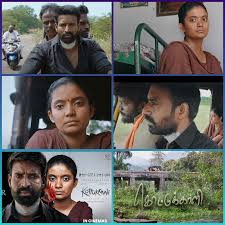
Sivakarthikeyan’s production, Kottukaali is a brave deviation from mainstream commercial cinema. The film stars Soori in the lead role opposite Anna Ben, supported by Poobalam Pragatheeswaran, Sai Abinaya, Jawhar Sakthi and Mullaiyarasi.
Paandi (Soori) returns from abroad to marry his murai ponnu, Meena (Anna Ben).
Meena, however, has fallen in love with someone else and refuses to marry Paandi. Meena’s family and Paandi conclude that the only reason for her refusal could be that she was bewitched, and they set off on a trip to rid her of this evil spirit. Their experiences on the way there, and their experiences when they eventually meet the priest who would perform the “exorcism” form the rest of the story.
Director H. Vinothraj has presented the journey from home as an intense one filled with visual metaphors and rich symbolism, with many of the film’s crucial issues being suggested, rather than shown or told to the audience. It is a journey where the unspoken words are far more powerful than the words uttered.
For example, the female lead has probably just one line of dialogue but her expressions and body language say so much about her, her situation and the relationships she has with Paandi and her family members. There are many references to patriarchy, both overt and subtle, and these are not limited to words in the script. Gender roles are looked at in an interesting way where the viewer decides on whether it is positive or not.
As a screenplay writer, S. Vinothraj is outstanding. The long tracking shots and the visual parallels that regularly punctuate the narrative shows an intense understanding of the complexity of gender relations. His characterisation is masterful, infusing personality into even the most minor characters in the film.
Soori is once again in magnificent form, showing an amazing degree of versatility in only his third film as lead actor. Anna Ben shows that one does not need dialogue to exude a powerful presence in the film.
Kottukaali is the first Tamil film to have no songs or music, except for 2 popular film songs in the background. This has a stunning effect on the film and the way it is perceived by the audience.
B Sakthivel’s creative cinematography is one of the film’s many positive aspects.
The film released at the Berlin International Film Festival last year where it was lauded for its originality. Unfortunately, a large percentage of cinema audiences have failed to understand the complexities of the film and have complained that they could not understand what the film was about. This is a pity because Kottukaali takes multiple steps toward redefining world cinema. It is not a commercial film, but one that engages its audience like few films can, culminating in the extraordinary climax.
The pace could have been better, but there is little else to fault this film which is truly a brave deviation from commercial cinema,
Kottukaali scores 9 points out of 10.