

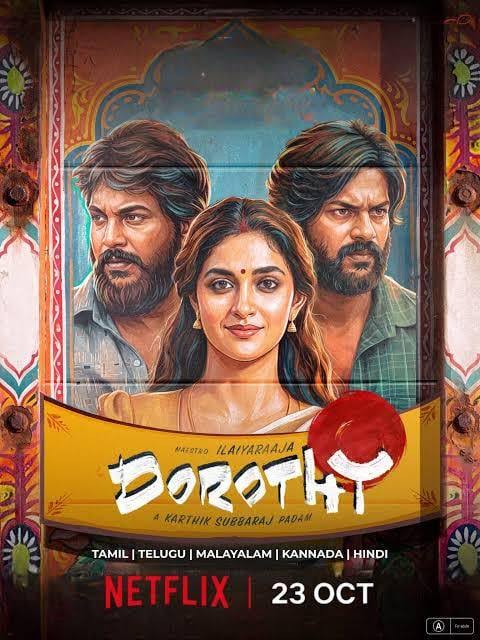
Karthik Subbaraj’s tenth film, Dorothy, has enjoyed increased footfalls and positive reviews in its 29-day theatrical run before its release on Netflix at midnight on 22 October. The film had premiered at the Toronto International Film Festival on 11 September 2026 where it received a standing ovation, but its release in India on 25 September was fraught with much controversy, negativity from some quarters and a ban on its release in Dubai and Malaysia.
The first advice to everyone is that one should avoid any social media posts about the film and to also avoid reading any reviews about the film (including this one) until one has watched the film. Like any good film, the magic of Dorothy is its cinematic excellence and the many surprise elements in the narrative.
Dorothy breaks every mould in Indian commercial cinema and even treads fresh ground with its technical aspects.
The film deals with the close friendship between Karthi (Rishikanth) and Subbu (Sananth) and their inevitable entrance into the world of gangsters and violence. Their world changes soon after the arrival into Subbu’s family of his new sister-in-law, Dorothy (Keerthy Suresh).
Whatever descriptions one can use, it would be inadequate to describe the level of excellence achieved in Dorothy – and this extends to every aspect of the film – from the writing to the technical team and the performance of each member of the cast.
Sananth is definitely the best of the cast with a performance that would rank as among the finest by any actor in decades. If this performance does not win a national award, that award would lose its meaning. One frequently hears about how an actor begins to live a role instead of acting, where one forgets that it is an actor in a performance and begins to believe wholeheartedly in the character on screen. That is the power of Sananth’s performance in his role as Subbu.
Following his stunning performance in Modha Rathri, Rishikanth exceeds expectations with a convincing and lingering portrayal of Subbu’s friend Karthi. His powerful expressions, especially in the non-verbal scenes make him also a close contender for the national award.
Keerthy Suresh’s acting goes beyond her screen time with a soul-stirring performance.
Muthukumar as the whistling Veeraiya and Ramachandran Durairaj as Vadivu are both electrifying in their respective performances.
Gajaraj as the Parotta Master and Jeeva Subramaniam as the transgender prostitute are relatively minor characters who have risen to prominence in the film through the strength of their portrayals and tight writing.
Childstars Varun (as the young Subbu) and Thihaan (as the young Karthi) show tremendous promise through realistic and powerful performances.
The story by Karthik Subbaraj and Saravanan Chandran has been carefully crafted to ensure that each character is given equal treatment. Karthik Subbaraj’s script and non-linear screenplay ensures a high level of engagement throughout the film. The simplicity behind the film’s most memorable lines mark the quality of writer that Karthik Subbaraj has evolved into.
Cinematographer Tirru – who made his debut in Magallir Mattum and worked with Karthik Subbaraj in films like Mercury, Petta and Jigarthanda Double-X – makes a memorable contribution to Dorothy, with world class innovation in framing, lighting, angles and light usage that even the untrained eye would easily notice.
Karthik Subbaraj must be praised for his bravery in tackling the theme, his journey into unchartered territory and the intensity of the film as a whole. He has presented the unembellished face of a side of India that exists and this warts-and-all approach shows guts, and is indicative of a director who is confident in his product. It is also laudable that Karthik Subbaraj has not made the mistake of under-estimating his audience. There are crucial aspects of the story or screenplay that are dropped almost in passing or in a cursory fashion – and it is up to the viewer to note and digest. Dorothy does not appear to be a film aimed at a particular audience, but a film made as a sincere expression of the director’s thoughts. Through this film, Karthik Subbaraj has earned himself a place in the list of top Indian directors.
Over the visionary brilliance of the director, one person’s contribution stands above everyone else, catapulting the film into another level – and that is the contribution of Isai Nyaani Illaiyaraja who underscores the reason for his fifty-year dominance in an amazing background score that rivals even his best from his first decade as a music composer. The music elevates or transforms the mood of each scene, often allowing silence to heighten the emotions. The songs are brilliantly composed and expertly placed, with all three boosting the impact of the film. In addition, Illaiyaraja’s soulful lyrics tear into the soul and stays there long after the film ends. Illaiyaraja deserves a national award for each of his three portfolios in the film.
The only negative side of the film – which is no fault of Karthik Subbaraj or his production team – is the expletive-ridden English subtitles which are often not even reflective of the actual Tamil words spoken. The first half, in particular, has extremely strong language in the subtitles.
Dorothy is not necessarily a film meant to educate or advise, but it will certainly force its viewer to think deeply about the issues raised. Its commentary on gender roles, gender stereotypes and gender behaviour is a starting point to the many issues explored and the end result is a film that reaches deep into one’s soul.
Dorothy scores 10 points out of 10.

Spoiler-free Review of “Dorothy” – Now streaming on Netflix
Post Views: 2 Karthik Subbaraj’s tenth film, Dorothy, has enjoyed increased footfalls and positive reviews in its 29-day theatrical run before its release on Netflix
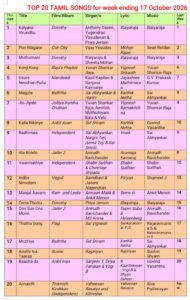
TOP 20 TAMIL SONGS for week ending 17 Oct 2026
Post Views: 7 2nd week at Number 1 for “Kalyana Virundhu” from “Dorothy” and one new entry. This week’s Top 20 – Click Here to

Cine News Digest – 18 Oct 2026
Post Views: 8 Rajinikanth’s Jailer 2 on its way to smash records Jailer 2 is hurtling towards the 400-crore mark globally and could become Tamil

Spoiler-free Review of “JAILER 2”
Post Views: 10 Nelson Dileepkumar’s sequel to his 2023 Rajinikanth starrer, Jailer, is a sincere and earnest attempt to improve on the original. Nelson has

Music Composer Deva dies at age 75
Post Views: 9 Respected and popular music composer Deva – popularly known as Thenisai Thendra Deva – passed away earlier this morning at the age
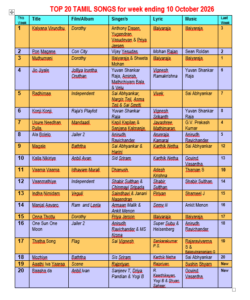
TOP 20 TAMIL Songs for week ending 10 October 2026
Post Views: 14 Click here to watch all 20 Songs or select your favourite Facebook Twitter LinkedIn