

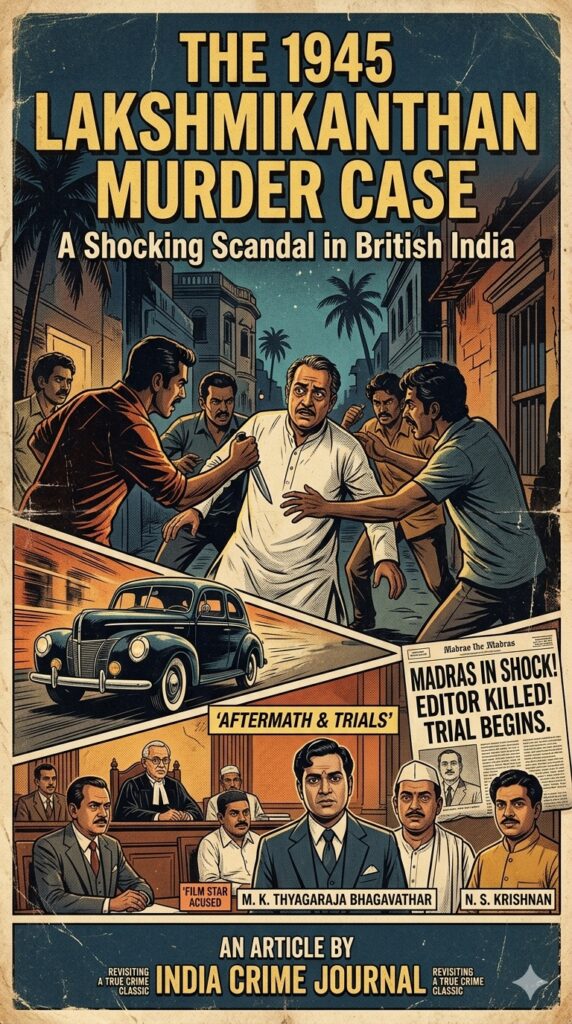
Tamil cinema and the state of Tamil Nadu had a real-life murder mystery that brought unwanted attention to an industry struggling to survive during the Second World War.
The murder victim
Lakshmikanthan was unable to pay for further education and worked as an illegal tout outside the Chennai High Court. He was eventually arrested in 1932 and sentenced to seven years’ imprisonment at the Andaman Islands Cellular jail.
In 1939 during World War 2, the Japanese occupied much of the Andaman Islands, leading to the release of many prisoners. Among them was Lakshmikanthan. He returned to Chennai where he tried unsuccessfully to land a job.
Lakshmikanthan vs the film industry
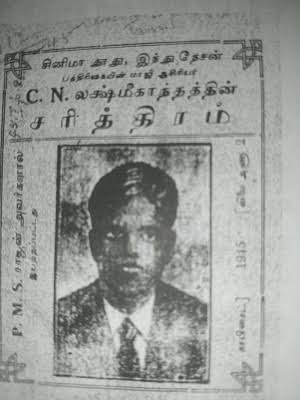
The saga began in 1954 when journalist C.N. Lakshmikanthan launched a weekly magazine called Cinema Thoothu, Lakshmikanthan’s prime aim was to expose the lives of the cinema stars and often stretched the truth or fabricated stories. In addition, he used extortion and blackmail to enrich himself from the cinema elite.
His technique worked and the copies flew off the stands as people scrambled to get a glimpse of the sordid lives of some of the cinema stars.
In 1943, M.K. Thyagaraja Bhagavathar and N.S. Krishnan petitioned th Governor of Madras – Arthur Oswald James Hope – to revoke the publishing licence. The Governor banned Cinema Thoothu because of what was termed “vulgar and obscene” content.
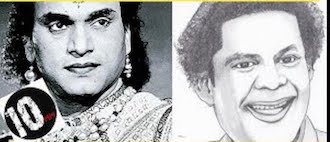
In response, Lakshmikanthan rook over as editor of another publication called Hindhu Nesan in February 1944. Lakshmikanth targeted Tamil cinema’s first superstar, M.K. Thyagaraja Bhagavathar and the legendary comedian, N.S. Krishnan, frequently printing scandalous articles on both of them.
In addition, Lakshmikanthan wrote scandalous articles on other film stars and successfully extorted large sums of money from others.
Lakshmikanthan attacked
On 19 October 1944, Lakshmikanthan survived a stabbing attempt by a local newspaper employee called Vadivelu. The police dropped the cast because of a lack of evidence or witnesses.
On 08 November 1944, Lakshmikanthan was attacked and stabbed in the abdomen on General Collins Road in Vepery by two unknown assailants. Amazingly, Lakshmikanthan walked to the nearest police station where he gave a detailed statement before admitting himself to the Government General Hospital.
Although his injuries did not seem life-threatening when he had gone to the police station, he passes away around 03h00 on 09 November 1944.
Investigation, trial and sentencing
A police investigation began with the written statement from Lakshmikanthan being the main document. Vadivelu, who had attacked Lakshmikanthan a month earlier was named alongside Nagalingam as the two men who actually stabbed him. Following their arrest, Tamil Nadu residents were shocked when police then arrested M.K. Thyagaraja Bhagavathar, N.S. Krishnan and producer S.M. Sriramulu Naidu.
The trial commenced in April 1945 at the Madras High Court under British Judge Vere Mockett and a nine-man jury – one of the last high profile cases in Chennai to have a jury.
Within a month, S.M. Sriramulu Naidu was released but the two attackers – Vadivelu and Nagalingam – were found guilty of murder, while M.K. Thyagaraja Bhagavathr and N.S. Krishnan were found guilty of conspiracy to murder and abetment. All four were sentenced to life imprisonment.
Appeal
On 29 October 1945, Bhagavathar and Krishnan both filed for appeal but Judge Alfred Henry Lionel Leach of the Madras High Court dismissed the appeal and upheld the life sentence.
Between 1946 and 1947 the actors’ legal team led by legal expert V.L. Ethiraj appealed to Judicial Committee of the Privy Council in London to reopen the case. The Council ruled that the Madras High Court had overlooked anomalies and contradictions in the testimonies and ordered a retrial.
In April 1947, a fresh retrial was held and, with one of the factors being the imminent departure of the British before 15 August 1947, Bhagavathar and Krishnan were found not guilty and released unconditionally.
Aftermath of the trial
Bhagavathar lost most of his wealth while in prison and, despite the verdict of not guilty, lost 12 film contracts and his position as Tamil cinema’s superstar. N.S. Krishnan suffered a similar fate.
Unsolved mystery
The retrial ordered by the Judicial Committee of the Privy Council in London raised many questions about the sentencing of all four, raising questions about whether Vadivelu and Nagalingam were truly guilty. After being stabbed, Lakshmikanthan did not name his attackers in his statement to the police. Mysteriously, he also did not name his attackers on his admission to Madras General Government Hospital.
These were the key reasons for the key trial because the Counsel for the accused maintained that guilt beyond any doubt was not proven.
It remains today an unsolved mystery.

Spoiler-free Review of “Dorothy” – Now streaming on Netflix
Post Views: 10 Karthik Subbaraj’s tenth film, Dorothy, has enjoyed increased footfalls and positive reviews in its 29-day theatrical run before its release on Netflix
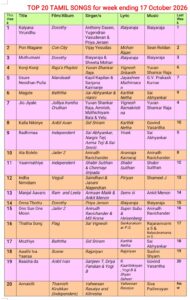
TOP 20 TAMIL SONGS for week ending 17 Oct 2026
Post Views: 9 2nd week at Number 1 for “Kalyana Virundhu” from “Dorothy” and one new entry. This week’s Top 20 – Click Here to

Cine News Digest – 18 Oct 2026
Post Views: 10 Rajinikanth’s Jailer 2 on its way to smash records Jailer 2 is hurtling towards the 400-crore mark globally and could become Tamil

Spoiler-free Review of “JAILER 2”
Post Views: 12 Nelson Dileepkumar’s sequel to his 2023 Rajinikanth starrer, Jailer, is a sincere and earnest attempt to improve on the original. Nelson has

Music Composer Deva dies at age 75
Post Views: 11 Respected and popular music composer Deva – popularly known as Thenisai Thendra Deva – passed away earlier this morning at the age
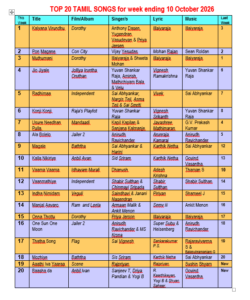
TOP 20 TAMIL Songs for week ending 10 October 2026
Post Views: 16 Click here to watch all 20 Songs or select your favourite Facebook Twitter LinkedIn