
Tamil Cinema and the elusive 1000-crore benchmark – Episode 2

Table of Contents

Episode 1 looked at the current state of the Tamil Industry and provided a background to the question many have recently asked – Why has Tamil cinema failed to record a 1000-crore film?

Episode 2

Presentation of Content: Political and Social Ideology

Entertainment media could also be used a catalyst for social and political reform, but glorification of a single school of thought is nothing short of propaganda. From the mid-1930s, the Tamil film industry has been largely influenced by writers and directors on the left and far left spectra. The propagandist tactics worked – as proof can be found in the way Tamil Nadu politics is still dominated by the left. While Tamil Nadu remains a largely theist society where religion and religious practices dominate almost all events, Tamil films depict a society that is either silent on religion and religious practices, or harshly critical, Proof of this is how the religious-based Hindu films that once formed a significant part of mainstream cinema has been completely neutralised by the combination of a leftist government and a leftist-dominated film industry.

The deification of Periyaar and the likes of Che Guevara, Stalin and Lenin have played a significant role in Tamil cinema over the last decade. It is difficult to see any film that does not have posters, banners or frames prominently featured, regardless of the genre of the film.

The shunning of anything Brahmin-related in the film industry has reached an alarming stage to the point that even a biopic like Soorarai Pottru had its main character drastically changed to suit the political agenda of its lead actor, Suriya. There is nothing wrong with being politicized, but when a film industry is as politicized as the Tamil film industry, it has a detrimental effect on the artistic integrity of the industry as a whole.

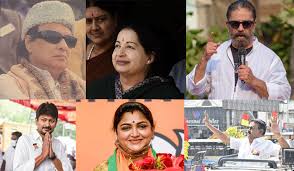
In Tamil Nadu, the political control goes well beyond an instrument of influence. The number of active politicians in the film industry is at an unhealthy high and this has had a direct bearing on the leadership of key organisations that represent different sectors of the film industry. This means that lobbies like the Nadigar Sangam and Producers’ Association have been largely controlled (and divided) by political ideology instead of being developed to grow the film industry as a whole.

With the DMK in political power in Tamil Nadu, it is surprising that few are questioning the active participation of Sun Pictures and Red Giant Movies in every major film production in Tamil Nadu, either through distribution or by producing films. It creates a situation where unbridled power and influence acts as intense repression of alternative ideas and alternative socio-political views.

Law & Politics

For a country and nation that has shown such remarkable innovation, it is baffling that Indian politics remains in the 19th century. It takes anyone with any kind of private agenda to be able to halt the release of a film. All it takes is someone claiming plagiarism or money owed, and a film that has had hundreds of people depending on its release could find itself looking for an alternative release date. While it may be a headache to theatre owners in India, it is a source of huge embarrassment for those trying to promote Tamil films outside of India. Two of South Africa’s major film exhibitors have expressed reservations about booking screens for Tamil films as, on at least three occasions thus far, screens were booked and advertising paid for – only to have the film withdrawn at the eleventh hour. It is equally frustrating when a release date is announced and then postponed because of poor planning from the production team. That is not the way it works in the rest of the world and Tamil cinema simply has to change to join world cinema as a serious role-player.

Facebook
Twitter
LinkedIn

Film Review: “29”

Post Views: 13 Lokesh Kanagaraj and Karthik Subbaraj come together as producers in the film 29. Rathnakumar, who made his directorial debut with Meyaadha Maan

Read More »

Table of Contents