In Part 1 we discussed the pioneers of Indian Cinema and the progression from silent films to the release of the first film with sound in 1931.
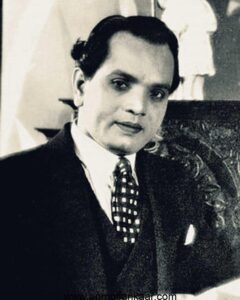
PK Nagalingam was renamed Raja Sandow after the German bodybuilder, Eugen Sandow, because of the former’s muscular build. He was the first director to introduce socio-political themes in silent films like Peyyum Pennum 1930), Nandhanar (1930)and Anadhai Penn(1931). After a successful stint as actor and director in Bombay, he returned to the south in 1935 and directed the film, Menaka.
Raja Sandow had some unique and some dubious firsts. He was the first Tamil director to move away from Puranic and religious films to produce and direct films with strong social reform messages. He controversially introduced kissing to the screen and also had scantily clad female dancers on screen. He was also the first director to base a film on a literary novel: His 1931 film, Anadhai Penn was based on a novel of the same title. The Tamil Nadu Government currently has an annual award named after him – The Raja Sandow Memorial Award – which is awarded for outstanding service to Tamil Cinema.
In the year 1934, a total of 13 Tamil films were released. The fifth release for the year was Pavalla Kodi, a landmark film that marked the screen debut of Tamil Cinema’s first superstar, MK Thyagaraja Bhagavathar. The film also marked the directorial debut of K Subramanyam. The film had a hugely successful run of 275 days and featured music by Papanasam Sivam in his second film, Pavalla Kodi had 50 songs, 22 of which were sung by M.K. Thyagaraja Bhagavathar.
The first release of 1935 was Alli Arjuna which introduced AV Meiyappan as a producer who had earlier launched his own production company, Saraswathi Sound Productions. AV Meiyappan would later start AVM Productions and AVM Studios, one of the most successful production houses of Tamil cinema.
The penultimate release of 1935 was Subhadra Parinayam which was produced by Samikannu Vincent (Refer to Part 1 of this series) and featured cinematography by German nationals Paul Brix and Bilmeyer Berkle. There was no music composers. The actors sang the songs and music was played by the studio orchestra. The film featured SV Subbaiyah Bhagavathar in the lead role.
In Part 3 (coming soon):
Tamil cinema’s first female director and an American director introduces MG Ramachandran to the screen

K. Bhagyaraj Special 4: Classic Film Review: “Darling Darling Darling”
Post Views: 9 K. Bhagyaraj’s ninth directorial was a marked move away from his previous films. While his earlier films focused on story and content,

TOP 20 Tamil Songs for the week ending 03 July 2026
Post Views: 10 We start off the second half of 2026 with three new entries and a new number 1. Don’t forget to vote for

K. Bhagyaraj Special 3: Classic Film Review: Thooral Ninnu Pochu
Post Views: 14 K. Bhagyaraj’s seventh directorial, Thooral Ninnu Pochu, sees him play the lead role opposite Sulakshana. The supporting cast includes M.N. Nambiar, Senthamarai,

History of Tamil Cinema – Episode 15
Post Views: 12 MGR as villain in Saalivaahanam This film released on 16 February 1945 and starred Ranjan opposite T.R. Rajakumari. Directed by B.N. Rao,

K. Bhagyaraj Special 2: Classic Film Review: Andha 7 Naatkal
Post Views: 13 Inspired by the life of J.P. Chandrababu, K. Bhagyaraj’s sixth directorial. Andha 7 Natkal, is a moving love story with lots of

K. Bhagyaraj Special 1: Classic Review: “Vidiyumvarai Kaathiru”
Post Views: 18 K. Bhagyaraj’s Vidiyumvarai Kathiru, released theatrically on 08 May 1981, was his fifth directorial and was a film that was decades ahead