Despite a painfully slow-paced first half, Maareesan stands out as a memorable and hard-hitting film that has multiple messages for society. While the core story is clear enough – eventually, the film deals with a myriad of emotions of ordinary people, often holding up mirrors to the audiences at the most awkward times. These are the features that make Maareesan an unforgettable film.
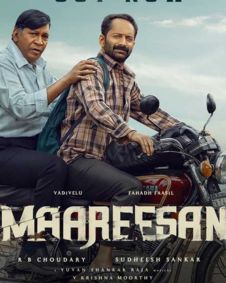
Fahadh Faasil plays Dhayalan, a petty thief who often spends time in prison. After being released from his last imprisonment, he comes across a man (Vadivelu) handcuffed to the window. Eager to get some quick money, Dhayalan makes a rushed pact with the man for some money, but the relationship – planned to last a few minutes – gets indefinitely extended when Dhayalan discovers something about his new companion.
The road trip that emanates from this chance encounter is both literal and figurative, transforming its genre early into the film’s second half.
There is no doubt that Fahad Faasil is one of India’s finest actors and his role in Maareesan is further confirmation of this. His facial expressions, emotive eyes and his ability to convey emotions through subtle body language are combined here with a rich, textured but flawed character. His portrayal of Dhayalan is one of the finest of any actor in the past year.
Vadivelu, who has often given glimpses of his ability to play serious roles, unveils a new dimension to his acting repertoire that goes well beyond what was shown in Maamannan. He too goes beyond his own standards and is surprisingly adept at conveying various emotions through his eyes. His performance is both moving and credible.
Kovai Saralla, as the Assistant Commissioner is also in an uncharacteristic but intensely credible role, minus histrionics and melodrama.
Vivek Prasanna once again shows the ease with which he can play virtually any character with the required credibility, proving to many in this film that he is still an under-rated and under-utilised actor.
Yesteryear actress Sithara plays a relatively small but very powerful role, while Renuka as Dhayalan’s mother impresses despite her short time on the screen. Livingstone also makes a memorable cameo.
One of the greatest strengths of the film is the powerful script by V. Krishnamoorty. There is nothing ostentatious about the scripting, but it travels well beyond the seemingly ordinary exchanges, digging deep into the soul through its authenticity. Krishnamoorthy shows that one does not need flowery or lengthy monologues or melodramatic exchanges to reach deep into one’s soul.
Providing brilliant support to the acting and script is a very lively and animated background score from Yuvanshankar Raja. His elevated performance is evident when the film starts and only intensifies as the film progresses. He is not as impressive with the two songs in the film.
Kalaselvan Sivaji’s cinematography has numerous high points throughout the film. His experiment with the film’s various palette complements his subtle use of light changes to support the film’s narrative.
The film’s major flaw is the very slow pace of the first half although the slow narrative contains many crucial elements that take on new meaning and new significance in the second half.
The fight scenes, while well-coordinated, had some major lapses that editor Sreejith Sarang either did not see, or deliberately ignored.
Maareesan is definitely a movie that everyone should see because of its many relevant allusions or lessons.
Maareesan score 7 points out of 10. It will be streamed on Netflix from 22 August 2025.