Rajinikanth is one of the most iconic actors in Tamil film history with a cult-like following that venerates him almost as a God. He turns 74 on Thursday, 12 December but he enjoys adulation from little children to seniors and his fame has spread far beyond the Indian borders. Despite numerous health challenges, he continues his acting career, often acting under the direction of very young directors.
What has made Rajinikanth a superstar? It is a question that has puzzled film journalists and even his detractors. His recent films do not show much depth in acting, his dancing skills have now withered and his ability to move has been hampered by recent health challenges – but there is something magical about his movements. The exaggerated walk, the flipping of cigarettes (in earlier films) and a larger-than-life screen personality that often sees him perform almost superhuman feats are all characteristics that should not belong to the current film culture – but Rajinikanth’s magnetic charm and style has only grown despite these factors.
Rajinikanth has always been and probably always will be the people’s hero, but his current status did not come his way overnight. The story of the rise to fame of Rajinikanth is a fascinating story and would make an enthralling movie. There is still a lot about him that presents him as an enigma. His larger-than-life screen image has made it difficult for film journalists to write anything that could mar his image or anything that tries to show him as an ordinary human being. His is a story that needs to be told as it is an inspiring one that ought to instil in others the self-confidence that it is possible to change one’s personal circumstances with resolve, determination, hard work and a little bit of luck.
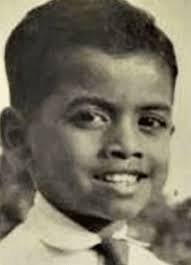
Rajinikanth was born Shivajirao Gaikwad on 12 December 1950 in a poor and rough suburb of the city of Bangalore in the South Indian state of Karnataka. He was the youngest son in a middle class family where luxuries were virtually unheard of.
His father was a police constable and the pressures of that job made him a stern and humourless man. Rajini says: “I cannot ever remember seeing him smile. He was always in a bad mood. I was very mischievous and my father frequently beat me severely.”
Rajini therefore did his best to stay out of his way – which usually meant joining bad company on the streets. “My brothers and my sister are blessed with good looks and a quiet disposition,” says Rajini. “I was the only dark-skinned, unattractive one, who also happened to be the noisiest and the most mischievous.”
Rajini’s mother, an asthma patient, was intermittently ill and bed-ridden for much of Rajini’s childhood. When his mother passed away, it was something that he did not fully grasp. Says Rajini: “More out of curiosity than out of fear, I went to the room. My sister held me in her arms and sobbed: Amma is dead. You have nobody. You’re just a little boy. Who will take care of you now?”
“I stood there, understanding nothing. I went outside and many people had come there to express their sympathies. My only concern was the sight of all the bicycles parked outside my house. It had always been my burning desire to learn how to ride a bicycle and I saw my chance.”
As his mother’s lifeless body lay inside, Rajinikanth rode a bicycle for the first time.. His sister came outside, took him in and made him sit. “Our mother is dead, “ she told him. “We don’t have a mother anymore.” She had to repeat this a few times before the little boy began to understood, and as he did, he began to sob uncontrollably. His mother had died and he had never seen her healthy. He had never known her love. He could barely remember her face and she was dead.
In the days that followed, Rajini’s misery grew. While his elder brothers were at school, he was alone at home with his father – so it was more beating and scolding. Rajini assumed that his father’s additional duties like cleaning the house and cooking made him an even more bitter man.
This, together with the fact, that his mother’s love was now a distant memory, made him into a mischievous, uncontrollable boy. Rajini says: “I strongly believe that if a child experiences love and compassion, he/she will grow into a good, well-balanced adult. Not only did I feel that did not have love from my mother – I also did not get any love from anyone else. As a child, nobody ever picked me up, carried me, or said something like What a cute or adorable child. After all, I was dark-skinned and ugly. I often wondered whether the sight of me had made my parents wonder whether they should keep me. I had already been responsible for my mother contracting asthma.” This feeling of inferiority had a lasting effect on the young Rajinikanth – a feeling that actively blocked out acts of love towards him from his own family….a feeling that was largely self-inflicted.
“I became even more rebellious and it didn’t matter anymore how much of beating my father gave me. Sometimes, unable to bear my nonsense, he even resorted to burning me with a hot poker – but that only made me more stubborn and rebellious. Once he even tried to attack me with a bush-knife and I had to seek protection from my neighbours.”
“Despite my bad behaviour, there was one person – only one person in this world – who showed me love and understanding, my eldest brother, Sathyanarayana.” Sathyanarayana would always ask his father not to hit Rajini, saying “He is just a little boy. He doesn’t understand.”
Paradoxically, this showing of love made Rajini even worse. When his brother would call him and lovingly tell him; “That is wrong. Please don’t do that again!” – Rajini would go out of his way to do the forbidden thing.
One day Rajini overheard his father speak to Sathyanaraayana. “I am old now,” he told Rajini’s brother. “I can no longer cook your food – You have to get married.” Rajini’s brother was only seventeen at the time – still at school and in no position to marry. For Rajini’s sake, Sathyanarayana left school and found himself a job – as a coolie (menial labourer), carrying bags of rice. Also for Rajini’s sake, Sathyanaraayana married at the age of 18. On the day of the nichayadhaatam (engagement), he told the family, “I am marrying for the sake of my little brother. He is mischievous but he needs mother’s love. My wife must be a mother to him and show him all the patience, love and understanding he never knew. Do not accept this proposal if you cannot accept these conditions.” His prospective bride and her family agreed to these conditions.
Supported and encouraged by his brother, Rajini completed his primary school education and started his secondary school education in Bangalore. This was a trying period for him as none of his friends were interested in school or studying. They were a bad influence on him and the education so well begun began to falter. One of the positive offshoots was his enrolment at a kind of mission school run by the Ramakrishna mission. There he was taught basic Hinduism, meditation and some basic Mantras. More importantly, he found himself interested in the small religious sketches and plays that were performed there and through that came his love for acting.
At the age of 15, he found a job as an office pune or office boy. Then, for a year, he worked as an assistant to a tailor. Thereafter, he worked as a coolie for two years. Then, he started his fourth job as a bus conductor. One day, at the bus depot, the workers held a short play in which Rajini played the role of Dhuriyodhanan. His co-workers were impressed and persuaded him to join the Film Institute. He then left Bangalore to study at the Film Institute in Madras – now Chennai.
In his final year of study, he met Iyakunar Sigaram K.Balachander. Balachander was impressed with this dark-skinned youth and liked the fiery eyes and the rugged looks and decided to offer him a small but important role in his forthcoming film Apoorva Raagangal – provided Rajini was prepared to learn Tamil. Rajini readily agreed. It was Balachander who gave Shivajirao Gaikwad the name Rajinikanth – based on the great stage performer and dramatist Chandhrakanth and after the lead character in Balachander’s thriller, Major Chandrakanth.
The year – 1975; when Balachander announced to the world that he had discovered a Karruppu Vairam – a Black diamond. From his very first film, audiences saw that the newly christened Rajinikanth was no run-of-the-mill actor. He was a fresh wave, with his unique style and mannerisms that made him stand out way above the others.
To be continued…
Do enjoy this Rajinikanth playlist: Click on the video below to start watching your favourite retro Rajinikanth songs:
Post Views: 3 Karthik Subbaraj’s tenth film, Dorothy, has enjoyed increased footfalls and positive reviews in its 29-day theatrical run before its release on Netflix
Post Views: 10 Nelson Dileepkumar’s sequel to his 2023 Rajinikanth starrer, Jailer, is a sincere and earnest attempt to improve on the original. Nelson has