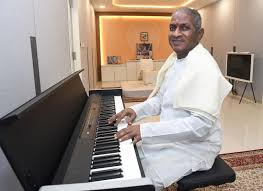
Thus far, this series has looked at a chronological synopsis of some of Illaiyaraja’s albums. This episode will briefly break away from that structural format.
Let us consider some questions asked by people who are not really fans of Illaiyaraja
- Is Illaiyaraja’s music still relevant in 2025?
- If Illaiyaraja is so talented, how is that he did not win an Oscar, or any other international award?
- Why has Maniratnam stopped collaborating with him?
- Is it true that Illaiyaraja’s popularity is nose-diving?
The rest of this series will provide responses to these questions, but I first need to qualify my input. I have virtually no understanding of Carnatic music. I recognize some of the base ragams and I have only the vaguest idea of how a base ragam can be transformed into various tunes with varying beats or Thalams. It is a shameful and embarrassing thing to admit, and something I wish I could change – not because I have a thirst to learn something new, but because I know that I would appreciate Illaiyaraja’s music much more than I currently do.
Something that I picked up in Illaiyaraja’s first decade of film music is the unmistakeable nativity in all his songs. Whether it is the rock feel of Madai Thirandhu from Nizhalgal, the pulsating rhythm of Hey Unnaithane from Kaadhal Parisu to the lilting ballads of Nilaave Vaa from Mouna Raagam and Sundhari Kannaal oru Sedhi from Thalapathy – there is one common factor in all of Illaiyaraja’s songs: They all have a strong Carnatic base in composition. This means that, regardless of how westernised the instrumentation is, an Illaiyaraja song could not be mistaken for a western pop song.
Unfortunately, many people gravitate towards western pop emulation. Anything that sounds like a western pop song seems to be the benchmark of what is considered to be a good song. These kind of songs would not change its effect if one had to change the words from Tamil to English (or any other western language). This means that many people want songs that have the same musical quality of western pop (and rap), where the lyrics have been substituted with Tamil lyrics, and where the singer’s pronunciation and inflections imitate the timbre of western pop songs.
A.R. Rahman’s Adiye from Kadal or Harris Jeyaraj’s Oh Ringa Ringa from Yezhaam Arivu will need no adaptation if the singer had to switch to English vocals. That would never happen to an Illaiyaraja song in even the most modern of his beats of rhythms.
It must be pointed out that there is nothing wrong with Adiye or Oh Ringa Ringa or any other westernised song, as long as western pop does not become the standard to measure how good a Tamil song is – and this is my gripe with the trend of new songs (with notable exceptions). It seems to be the goal of many music composers to attempt an emulation of western pop, instead of using elements from world music to enrich our Tamil music – and there is a world of difference between the two approaches.
I don’t advocate the purist attitude of trying to keep our music beyond the influence of other music styles. That would be a narrow-minded and stifling way of looking at music and not something a true music lover would do. I do, however, feel that Tamil music must embrace other styles, patterns and sounds without losing the essential Tamil quality of our music. This should extend beyond the language of the lyrics. The legendary MS Viswanathan got it right with his songs, and Illaiyaraja has taken this step further. The preservation of our Carnatic base is something that Tamil musicians need to take seriously.
It was Illaiyaraja who first incorporated rap in film songs in Kamalhaasan’s 1986 film, Vikram, but it was done in a manner that retained the Tamil flavour of the songs.
In addition to this unmistakable Carnatic base, Illaiyaraja’s musical preludes and musical interludes within his songs remain unmatched by any music composer before or after Illaiyaraja’s emergence on the music scene. The intricacy of the notations, the varied rhythms and the unusual blend of styles in the musical instruments deserve a separate study on its own. For many songs, the magic begins with the musical prelude where a full feast is given before the first course is served. After each course, the supporting feast continues and the different layers and aspects get more and more impressive with each listening.
In art, repeated exposure does not create a feeling of repetitiveness or. boredom. Real art gets better with each interaction. Whether it is a painting, a sculpture or Illaiyaraja’s music, the level of fascination only increases with each exposure.
Which song of Illaiyaraja cannot be left out of a Top 100 song list? Email us on sigaram.net.mail@gmail.com or, if you receive Sigaram links through WhatsApp, communicate with our Sigaram Team and vote for the Illaiyaraja song that should be included in our Top 100 Raja songs of all time.